
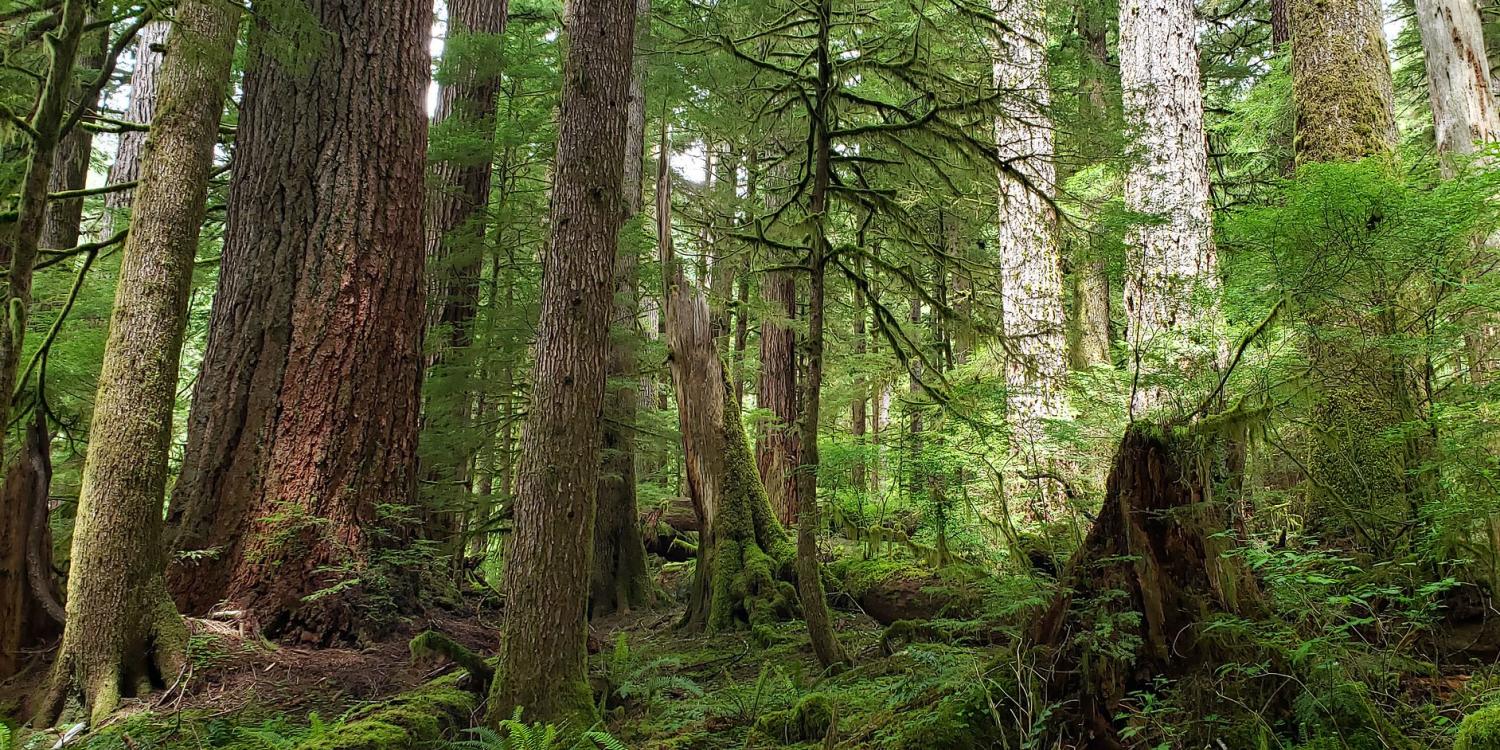
Mature and old-growth forests are among the Pacific Northwest’s most valuable natural assets. They store large amounts of carbon, provide wildlife habitat, support water systems and contribute to recreation, tourism and other public benefits.
The Northwest Forest Plan region — federally managed forests in Western Oregon, Washington and Northern California — includes much of the Pacific Northwest’s mature and old-growth forest.
By identifying the forests and regions with the highest exposure, the study supports more strategic decisions about restoration, stewardship and carbon protection.
Severe wildfire is now a leading threat to older forests on federal lands. As fires grow larger and more destructive, land managers and policymakers need better information on where mature and old-growth forests are most exposed to stand-replacing wildfire and where losses could have the greatest ecological and carbon consequences.
Until now, that regional picture has been incomplete. Risk varies by forest type, ecoregion and fire history, and mature and old-growth forests do not respond the same way everywhere due to topographic controls on fire behavior, and the influence of stand conditions. That variability created a need for a landscape-scale analysis to show where stewardship and restoration efforts may matter most.
Researchers in Oregon State University’s College of Forestry and the USDA Forest Service analyzed mature and old-growth forests in national forests across the Northwest Forest Plan region. They combined fire behavior simulations, forest type mapping, information on historical fire regimes, fire refugia data and carbon estimates to measure exposure to stand-replacing wildfire.
The study examined how exposure differed by national forest, ecoregion, forest type, and historical fire regime. The authors also evaluated whether areas with fire refugia capacity – which are places that burn less severely due to topographic setting and stand composition and structure — could be important features that help reduce losses of old forests. In addition, the researchers estimated expected carbon emissions tied to severe wildfire in these older forests.
Results identify where losses could be greatest
According to the study, published in the journal natural hazards, about 75% of mature and old-growth exposure to stand-replacing fire occurred in areas that historically experienced frequent, low-severity fire. The finding reinforces our growing understanding that long-term fire exclusion has left many historically fire tended forests vulnerable to stand-replacing fire. Active management is needed to conserve older trees and restore forests in dry, historically frequent fire settings.
High exposure to stand-replacing fire is concentrated in specific parts of the region, especially the Klamath Mountains and North Cascades ecoregions. By national forest, the Shasta-Trinity and Okanogan-Wenatchee had the greatest area of mature and old-growth forest exposure to high intensity fires, also resulting in the highest expected carbon emissions.
The analysis estimated an annual average of about 300,000 tons of carbon emissions from stand-replacing fire in mature and old-growth forests across the study area, equal to about 0.04% of the total carbon stored in those forests across the same region.
Fire refugia could potentially reduce the loss of older forest by 6% to 21across forest types. Locations on the landscape with fire refugia capacity are critical for maintaining existing older forests but also play an important role for recruiting more old growth over time.
Together, the findings give land managers a clearer map of where older forests face the highest wildfire exposure and where conservation, restoration and fuels work may help protect older trees and forests, and stored carbon.
Study authors included:
- Bruno Aparício, postdoctoral researcher, Department of Forest Ecosystems and Society, OSU College of Forestry
- Meg Krawchuk, associate professor, Fischer Family Faculty Fellow, Department of Forest Ecosystems and Society, OSU College of Forestry
- Michelle Day, biological scientist, USDA Forest Service, Rocky Mountain Research Station, Missoula Fire Sciences Lab, Montana
- Raymond Davis, wildlife biologist, USDA Forest Service, Pacific Northwest Region, Corvallis
- Rachel Houtman, biological scientist, USDA Forest Service, Rocky Mountain Research Station, Missoula Fire Sciences Lab, Montana
Detailed interactive maps and analysis from the study are available online.
Public value
This research gives policymakers and land managers better information to direct public investment where wildfire risk to mature and old-growth forests is greatest.
By identifying the forests and regions with the highest exposure, the study supports more strategic decisions about restoration, stewardship and carbon protection.
For Oregon and the broader Pacific Northwest, that matters economically as well as ecologically. Older forests support ecosystem services that underpin water resources, biodiversity and wildlife habitat, recreation, cultural values, and long-term landscape resilience.
Research that helps protect those assets improves the return on public investment in forest management and helps agencies focus limited resources where they can have the greatest impact.
Funding for the study was provided by the U.S. Forest Service, agreement 21-CS-11221637-130.