
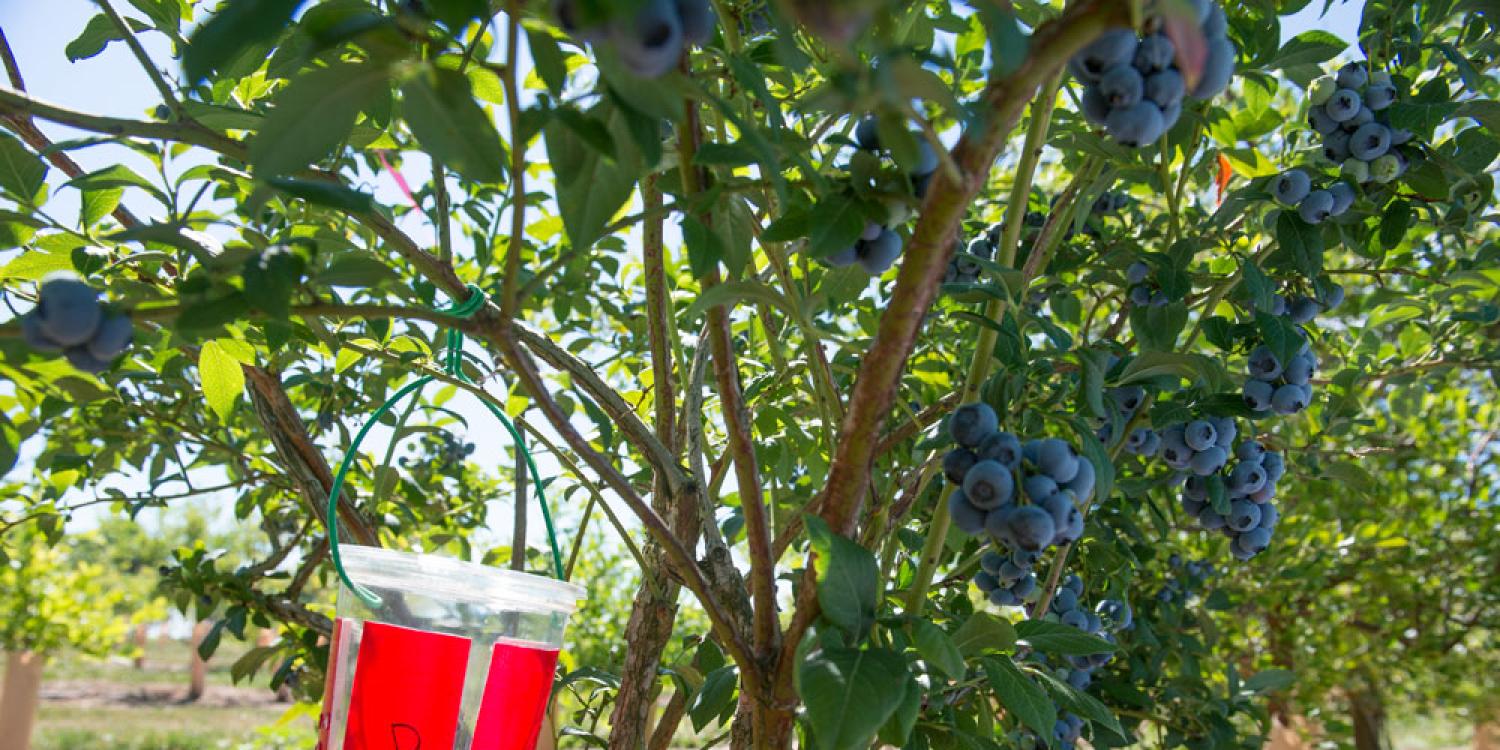
Spotted-wing drosophila is a small fruit fly that can ruin berries right before harvest. Unlike the fruit flies many people know from kitchens, it can lay eggs in firm, ripening fruit still on the plant. The eggs hatch into larvae that make berries soft and leaky, and even limited damage can make fruit hard to sell.
Better monitoring and more options can help farms control damage, manage costs and keep effective tools working longer, supporting a steady supply of high-quality fruit for the people and businesses that depend on berry harvests.
First detected in Oregon around 2009, spotted-wing drosophila is now established across many fruit-growing regions of the state. Risk can rise quickly as fruit ripens, and decisions often must be made during the busiest weeks of the season. Frequent insecticide sprays have been a common response, but they can be expensive and time-consuming and may contribute to pesticide resistance and impacts on beneficial insects.
Over the past 15 years, Oregon State University researchers and partners have worked through the Oregon Agricultural Experiment Station and the Oregon State University Extension Service to develop tools that help farms manage spotted-wing drosophila with better timing and fewer unnecessary inputs.
Published research in 2025 focused on three practical questions: How can growers detect problems earlier, before larvae show up in fruit? Can management reduce egg laying without relying only on insecticides? Can existing spray approaches be improved so they work better when sprays are needed?
One multi-state study, published in the Journal of Economic Entomology that included Oregon, tested where and how to sample fruit in berry fields. The main takeaway was clear. Check fruit at field edges and look for eggs and very small larvae. By sampling at the edges and focusing on early life stages, researchers found signs of infestation about two weeks earlier than when they sampled deeper in the field or looked for later stages.
The study also addressed workload. Researchers estimated that about 13 samples per location can detect early infestation with good precision, helping growers plan scouting that is realistic during a busy season.
An Oregon State study published in the Journal of Economic Entomology tested plant-based scent blends in blueberries. These blends release odors meant to draw flies toward a decoy smell. In lab tests and semi-field trials, several blends reduced egg laying on blueberries. The flies spent more time near the odor source and less time laying eggs in fruit, pointing to a potential future tool that protects berries by shifting fly behavior.
A third Oregon State-affiliated study in the Journal of Economic Entomology looked at spray adjuvants, which are products added to spray tanks to help sprays spread, stick or work better. Adjuvants alone did not consistently reduce egg hatch and caused little to modest adult mortality.
When researchers added sugar as a feeding attractant, two adjuvants caused high adult mortality after 72 hours and lowered egg laying, likely because sugar increased feeding and exposure. The results suggest some adjuvant-plus-sugar mixes could support feeding-based strategies and complement other tactics.
Taken together, this work points to more targeted, lower-waste pest control:
- Earlier detection can start with fruit checks at field edges and a focus on eggs and small larvae, giving farms more time to respond before damage grows.
- Scent-based blends may add options that reduce egg laying without relying only on insecticides.
- Research on adjuvants suggests some combinations may improve feeding-based approaches under the right conditions.
Better monitoring and more options can help farms control damage, manage costs and keep effective tools working longer, supporting a steady supply of high-quality fruit for the people and businesses that depend on berry harvests.
Funding for this research was supported by the Oregon Blueberry Commission; the Interregional Research Project No. 4, Northwest Center for Small Fruit Research; and the U.S. Department of Agriculture’s National Institute for Food and Agriculture, including the Specialty Crop Research Initiative (award No. 2020-51181-32140) and the Organic Agriculture Research and Extension Initiative (award No. 2022-51300-37890).
Additional support included USDA Current Research Information System (A. 0446923), USDA-NIFA OREI (award No. 2018-51300-28434) and USDA NWCSFR.