
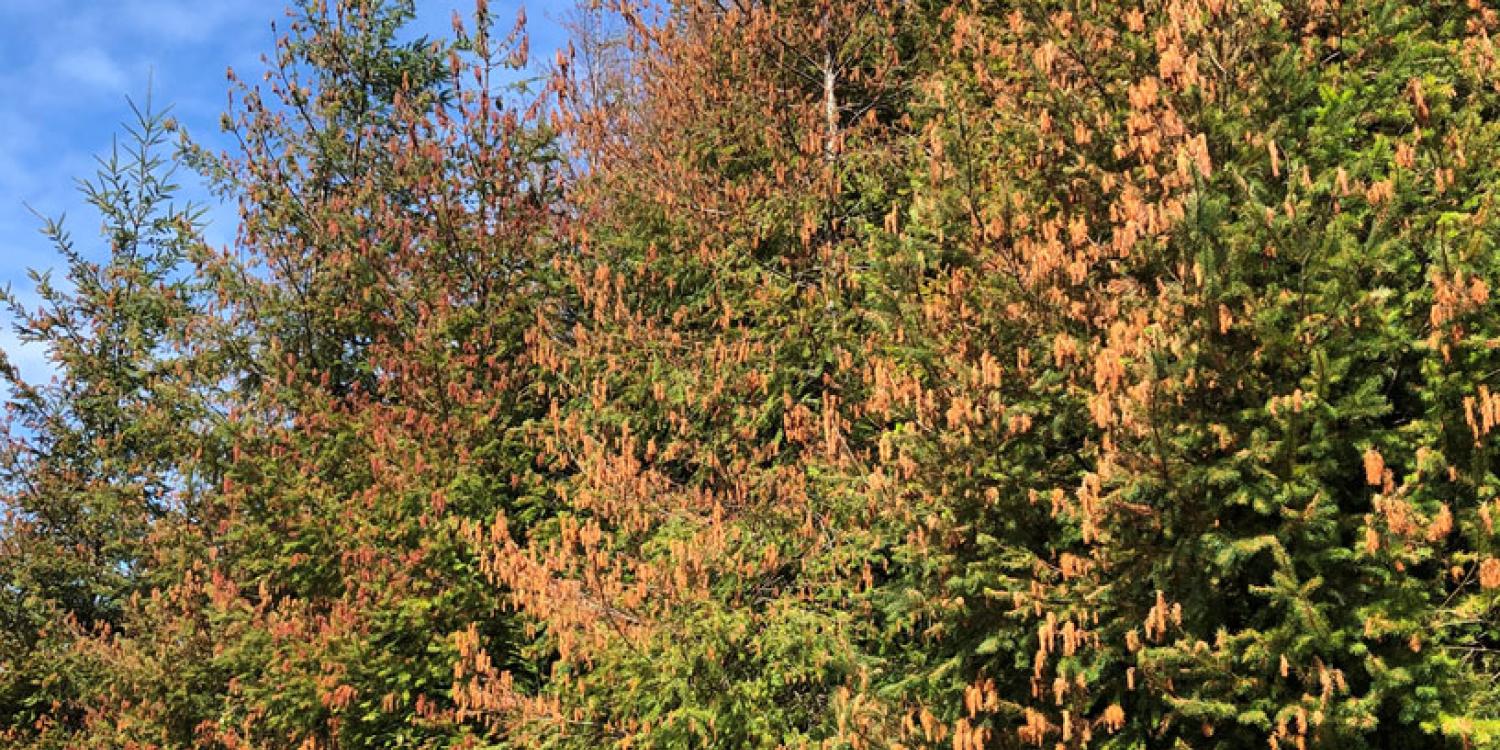
The 2021 “heat dome” brought record heat to the Pacific Northwest, stressing forests at a scale few managers had seen before. Extreme heat can scorch foliage in the forest canopy, reducing photosynthesis and leaving trees more vulnerable to pests and disease.
Researchers from Oregon State University’s College of Forestry and the U.S. Forest Service used satellite imagery to map canopy damage across Western Oregon and Western Washington after the heat dome.
They analyzed how landscape conditions such as sun exposure, microclimate and slope aspect were linked with damage. They also examined forest characteristics including species, stand age, budburst timing and the presence of foliar pathogens such as Swiss needle cast in Douglas-fir.
The analysis identified 293,546 hectares of damaged forest canopy — more than 1,000 square miles — representing nearly 5% of the forested area across Western Oregon and Western Washington. In affected areas, foliage shifted from healthy green to red or orange, sometimes within hours, indicating widespread canopy scorch.
The study, published in the journal Global Change Biology, found that western redcedar, western hemlock and Sitka spruce were disproportionately prone to heat damage, including in old growth stands where they dominate the canopy.
Researchers also documented extensive canopy scorch on Washington’s Olympic Peninsula, which includes Olympic National Park, where old-growth forests are widespread. Other areas with extensive canopy scorch included Douglas-fir plantation forests of the Oregon Coast Range.
For landowners, forest managers and policymakers, the findings offer a regionwide baseline of where extreme heat affected forest canopies, and which forest conditions were associated with greater vulnerability. That information can help agencies and partners target monitoring, prioritize assistance and plan for future extreme heat events that threaten forest health, timber productivity and ecosystem services.
This research was supported by the U.S. Geological Survey Northwest Climate Adaptation Science Center (award G17AC000218), the H.J. Andrews Experimental Forest and Long-Term Ecological Research program funded by the National Science Foundation (grant DEB-2025755), and the USDA Forest Service Pacific Northwest Research Station.