
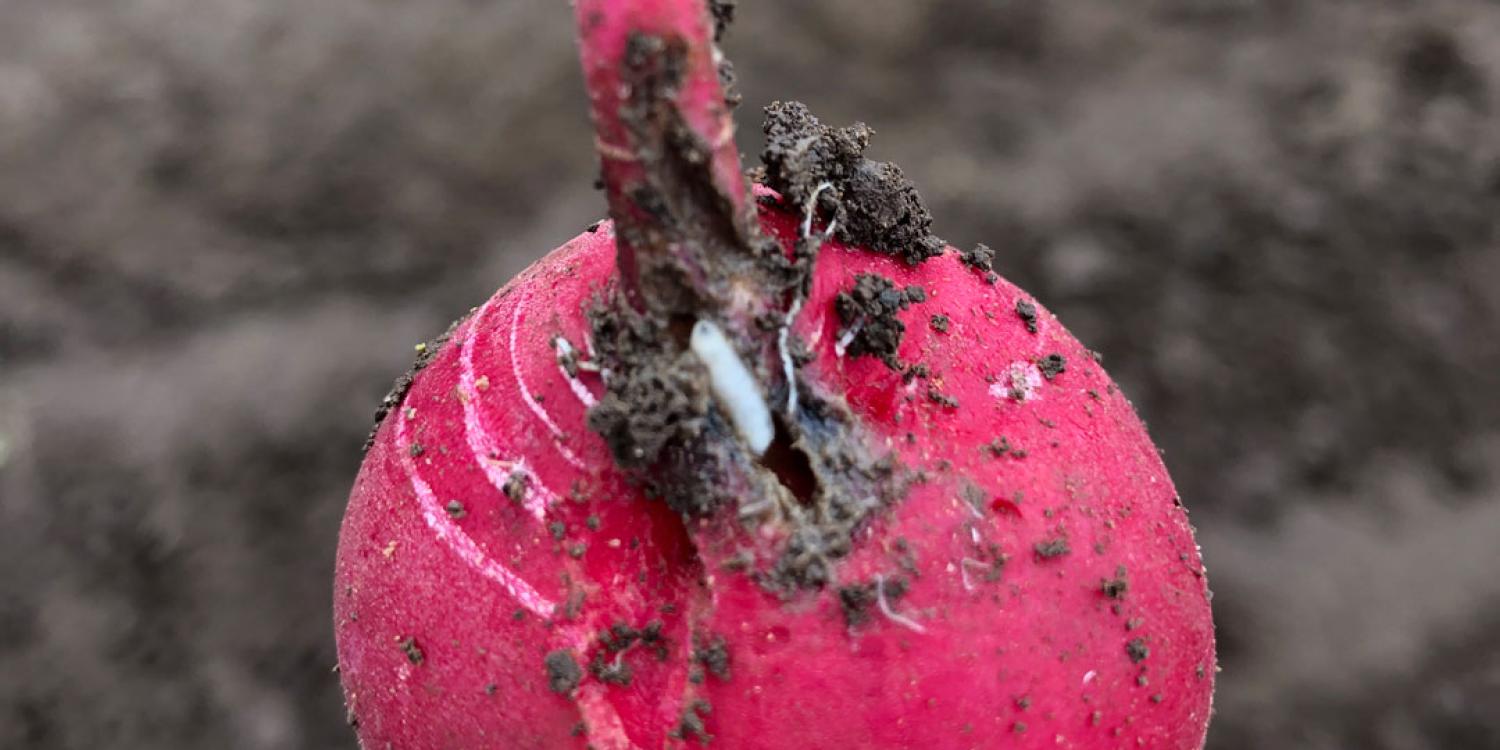
In Oregon’s Willamette Valley, cabbage maggot (Delia radicum) causes widespread crop damage and significant economic losses. Root vegetables such as radishes, turnips and rutabagas can’t be sold if they show insect feeding, and unfortunately, they are often grown during the times of year when cabbage maggots are most active — early spring and late fall.
This work protects the availability of locally grown vegetables, strengthens rural economies and supports sustainable farming practices that safeguard the environment as well as the state’s agricultural heritage.
Cabbage maggot is also a concern for crops like broccoli and cauliflower. These can tolerate some feeding if planted strategically, but growers must still manage the pest carefully. Brassica crops are grown in rotation on most annual vegetable farms in Oregon, which cover an estimated 300,000 acres statewide.
For decades, vegetable growers relied on chlorpyrifos-based insecticides, sometimes applied every 10 to 14 days, at a cost of up to $200 per acre. In 2020, the Oregon Department of Agriculture began phasing out chlorpyrifos due to toxicity concerns. In 2022, the U.S. Environmental Protection Agency banned its use on food crops nationwide.
A 2021 industry survey showed the impact: 100% of root crop growers reported cabbage maggot damage, and 44% estimated yield losses of 10% to 25%. Replacement pesticides can cost up to 10 times more than chlorpyrifos, underscoring the urgent need for affordable, effective alternatives.
In response, Kristine Buckland, associate professor and Extension vegetable and specialty seed crop specialist at Oregon State University’s North Willamette Research and Extension Center, partnered with Cornell University and the IR-4 Minor Crop Pesticide Registration Program to develop an IR-4 protocol for cabbage maggot control.
Over three years, Buckland led four insecticide efficacy trials, testing more than 20 alternative treatments. These efforts produced data for 16 promising products with new active ingredients and delivery methods. The results support pesticide rotation strategies that follow integrated pest management (IPM) principles and help reduce resistance.
Building on this success, Buckland secured $219,000 from the Oregon Department of Agriculture’s Specialty Crop Block Grant to expand research into innovative methods that target all three life stages of the pest.
The project also supports a master’s student research project and includes direct outreach to growers. Buckland has engaged 20 growers and agricultural professionals in workshops — the first regional events on cabbage maggot control in more than a decade. These workshops emphasize crop management practices and how to use insect degree-day modeling to predict pest emergence and improve treatment timing.
The team expects to identify at least three new on-farm strategies that are practical, effective and consistent with IPM principles. These solutions will help Oregon growers adapt to the loss of chlorpyrifos while maintaining crop quality and farm profitability.
For Oregonians, this work protects the availability of locally grown vegetables, strengthens rural economies and supports sustainable farming practices that safeguard the environment as well as the state’s agricultural heritage.