
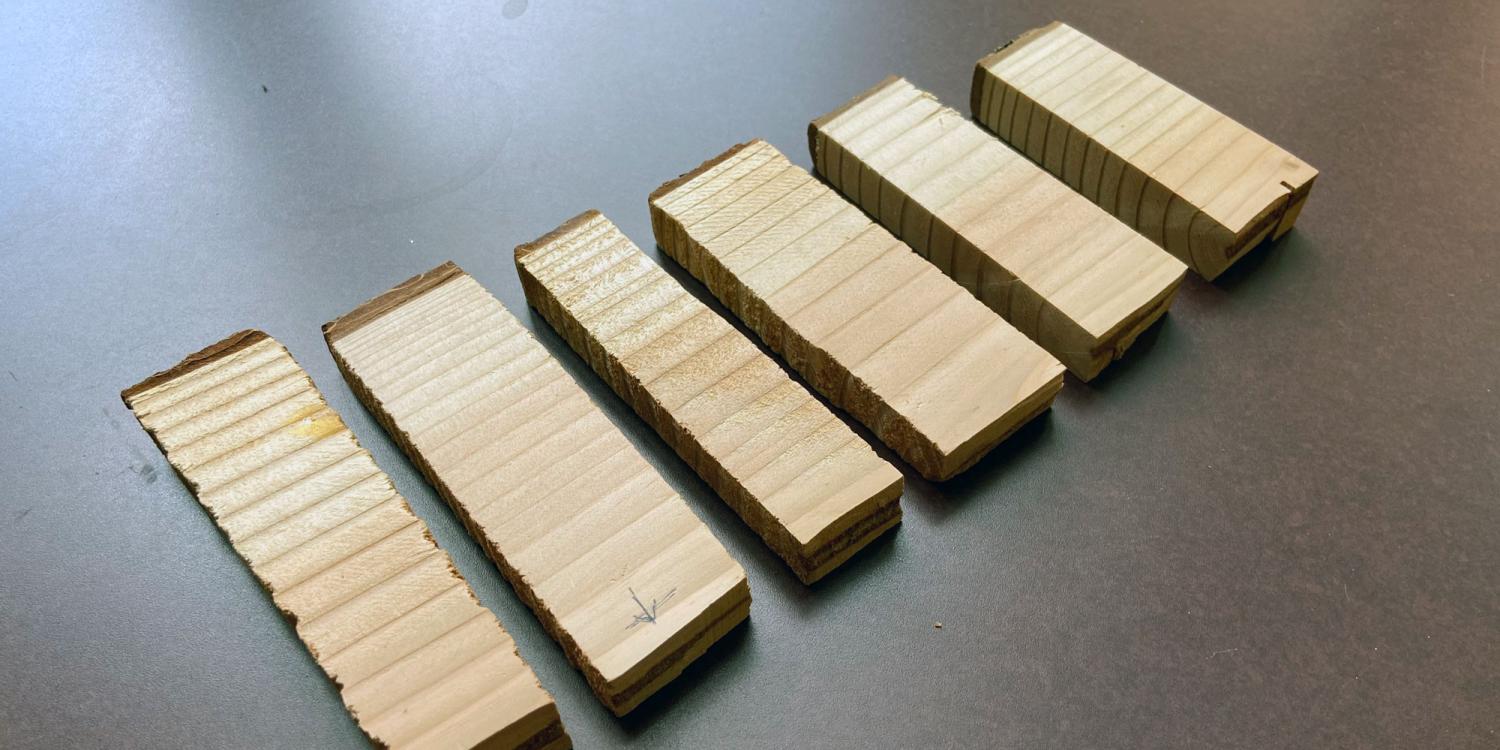
Douglas-fir is the backbone of Oregon’s timber industry and a major source of lumber, engineered wood products and manufacturing fiber in the Pacific Northwest.
Better knowledge of how spacing affects wood development can help the sector make more informed decisions about growing, processing and using Douglas-fir.
As growers and companies adjust planting densities over time, they need better information not only about how fast trees grow, but also about how forest practices affect wood quality and product value. Research on that relationship can help the industry better align forest management with manufacturing needs.
For forest managers and woodland landowners, the economic return from a stand depends on more than yield. Wood density, stiffness and related traits influence whether logs are better suited for higher-value structural products or lower-value uses. Yet those traits are difficult to measure within a tree, and the long-term effects of spacing decisions on wood quality are not always clear.
To help answer those questions, Oregon State University researchers studied how wood properties vary from the center of a Douglas-fir tree to the bark and how those patterns differ under different planting densities. The work adds to industry knowledge about how stand establishment decisions may shape timber value over time.
The researchers examined 25-year-old Douglas-fir grown at narrow, conventional and wide spacings. They used hyperspectral imaging to help them understand how strength, wood fibers and chemical makeup varied within the trees examined.
The study, published in the journal Wood Science and Technology, found that trees across the different spacings showed similar overall patterns, but narrowly spaced trees had more abrupt radial changes in wood properties than widely spaced trees.
Generally, as trees grew older, the wood became denser and stiffer, with longer and wider wood cells and more cellulose, a key material that gives wood strength. At the same time, some other components decreased.
Overall, the study suggests that planting trees closer together or farther apart may not change wood quality in a simple way, but it can affect how wood properties develop within the tree over time.
Useful evidence for industry decisions
The study does not suggest that most forest managers or family woodland landowners will begin using hyperspectral imaging themselves. Instead, its immediate value is in improving understanding of how silvicultural decisions can shape wood quality over time. That gives foresters, landowners and advisers stronger evidence for discussing spacing, stand development and long-term value, not just growth rate.
The findings are also relevant to mills and manufacturers that already consider wood properties such as stiffness and density when matching raw material to products. Research like this can help the industry refine how it thinks about log quality, product recovery and the relationship between forest management and manufacturing performance.
The study presents hyperspectral imaging as a promising research tool for studying within-tree variation, rather than as a technology already in routine use by most landowners.
The study was conducted by Ighoyivwi Onakpoma, the corresponding author and a Ph.D. graduate of the College of Forestry’s Department of Wood Science and Engineering; Professor Laurence Schimleck and Associate Professor Gerald Presley in the Department of Wood Science and Engineering, and Professor Joseph Dahlen at the University of Georgia.
Public value
For Oregon’s timber industry, the value of this work is practical and long term. Better knowledge of how spacing affects wood development can help the sector make more informed decisions about growing, processing and using Douglas-fir.
Over time, that can support better alignment between forest practices and end-product needs, improve value recovery from harvested trees and strengthen the competitiveness of Oregon’s forest products sector without requiring more harvest volume.
That kind of applied research matters in a state where timber continues to support rural jobs, manufacturing activity and local economies.