
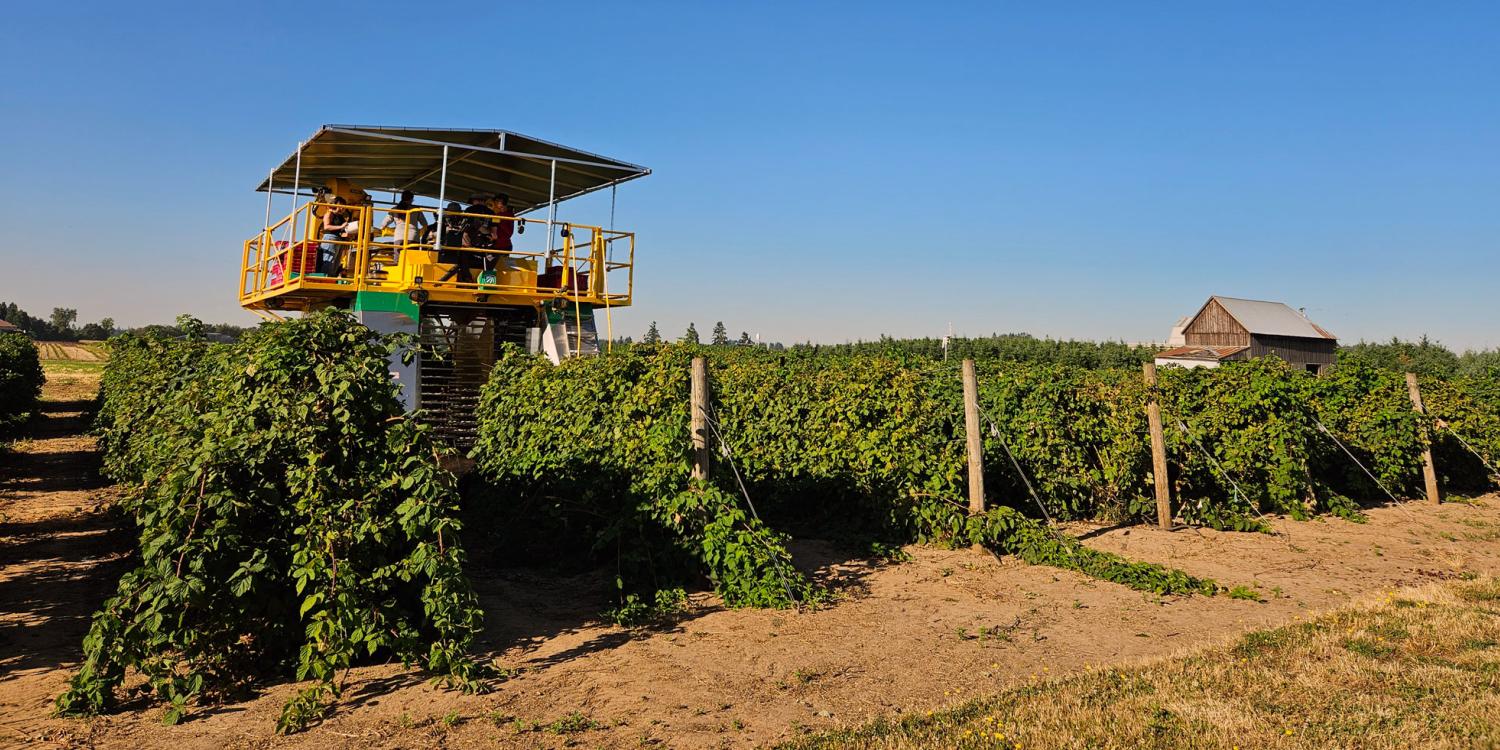
Oregon is a leading production state for machine-harvested trailing blackberries, an industry that supports growers, processors and rural communities. ‘Columbia Star’ has quickly become one of the region’s most widely planted cultivars because of its fruit quality, thornless canes and fit for the processed market.
By field testing a management system that sharply reduces labor needs while maintaining fruit quality and increasing yields, Oregon State helps growers make more efficient production decisions and strengthen long-term competitiveness.
But trailing blackberry production is labor intensive. Removing dead canes and training new canes onto a trellis each year accounts for one of the largest shares of production costs. At a time of high labor costs and ongoing workforce constraints, growers need management systems that protect yield while reducing hand labor.
Because ‘Columbia Star’ is still a relatively new cultivar, growers have had limited research-based guidance on how best to space plants and manage canes for machine harvest, fruit quality and profitability.
Researchers with Oregon State University and the U.S. Department of Agriculture’s Agricultural Research Service (USDA-ARS) established a field trial at the OSU North Willamette Research and Extension Center (NWREC) in Aurora to evaluate how plant spacing, primocane suppression and cane-training method affect production.
The study, published in the journal HortScience, compared two in-row spacings, two approaches to primocane management and two training systems: traditional August training and a reduced-labor new-over-old method in which new canes are trained over old, dead floricanes left on the trellis.
Researchers measured plant growth, yield, machine-harvest efficiency, fruit quality, labor time and economic returns over four production years.
New-over-old boosts returns, slashes training time
The study found that the new-over-old method substantially reduced labor requirements while increasing yields as plantings matured.
Compared with traditional August training, new-over-old reduced primocane training time by 87% at the closer spacing and 79% at the wider spacing. It also produced higher yields in the final two years of the study.
Closer spacing increased yield per hectare in the first two fruiting years, but that advantage did not continue as the planting matured. Primocane suppression increased cane number and reduced cane length, but it had little effect on yield and only modest economic benefit when combined with new-over-old training.
The strongest financial performance came from plants spaced at 0.75 meter and trained using the new-over-old method, followed closely by plants at 1.5 meter using the same method. In contrast, traditional August training led to an economic loss at the closer spacing and only small gains at the wider spacing.
The findings suggest that new-over-old training offers growers a practical way to reduce labor costs and improve profitability in ‘Columbia Star’ blackberry.
The study authors included:
- Amanda Davis, senior faculty research assistant, OSU Department of Horticulture
- Scott Lukas, associate professor, Endowed Professor for Northwest Berry Production and Management, Department of Horticulture
- Bernadine Strik, professor emerita, Department of Horticulture
- Scott Orr, biological science technician, USDA-ARS Horticultural Crops Production and Genetic Improvement Research Unit, Corvallis
- David Bryla, research horticulturist, USDA-ARS Horticultural Crops Production and Genetic Improvement Research Unit, Corvallis; courtesy appointment in Department of Horticulture
Public value
This research gives Oregon’s blackberry industry clear, field-tested guidance to improve returns in a high-value specialty crop.
By field testing a management system that sharply reduces labor needs while maintaining fruit quality and increasing yields, Oregon State helps growers make more efficient production decisions and strengthen long-term competitiveness. That supports farm profitability, processor supply and the rural economies connected to berry production.
The study shows the return on investment from applied agricultural research that addresses immediate labor and production challenges with practical, cost-saving solutions.
Funding was provided by the Oregon Raspberry and Blackberry Commission and the Northwest Center for Small Fruits Research, with in-kind support from Oxbo, Marion Ag Service, BirdGard and North American Plants.