
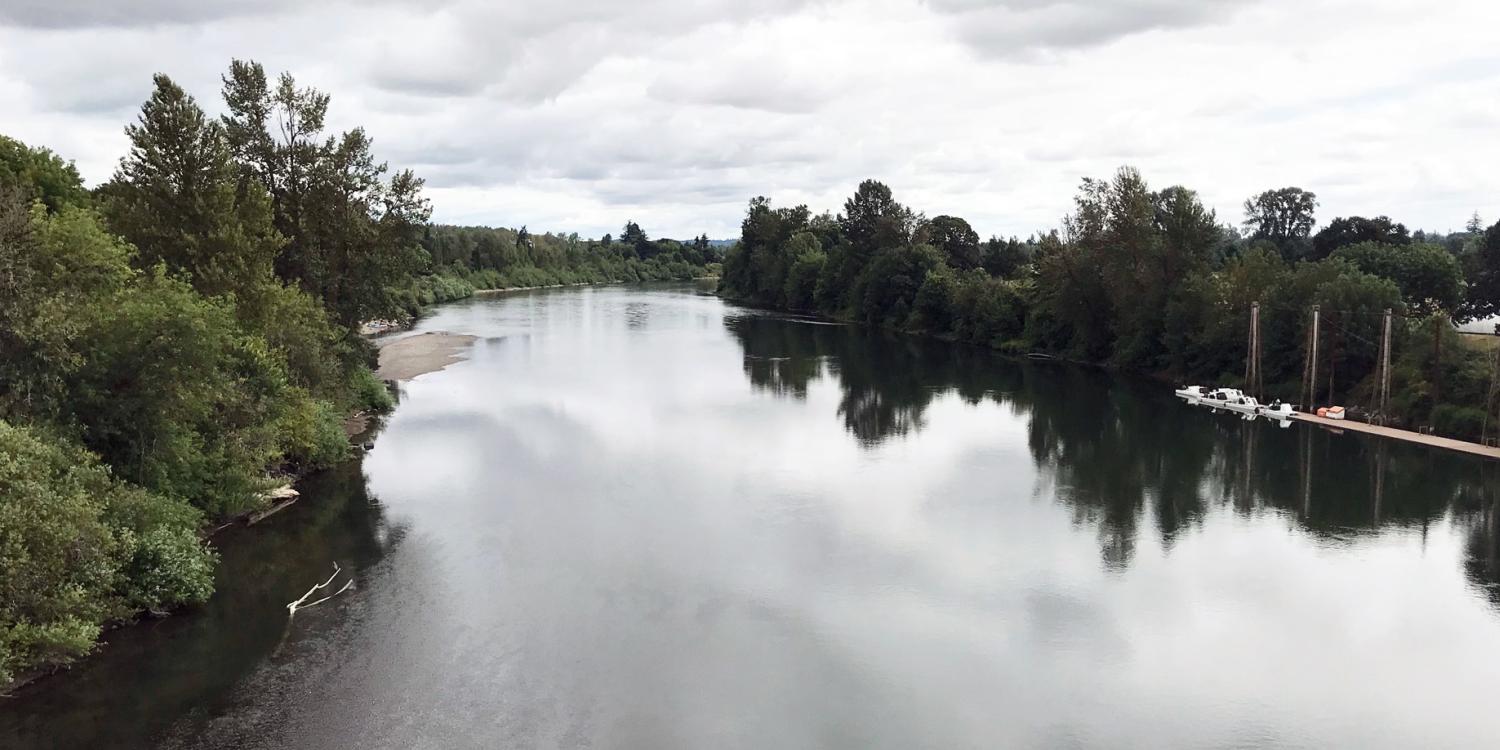
The Willamette River Basin is Oregon’s most populated watershed and supports much of the state’s agriculture, industry, transportation and fish and wildlife habitat.
In the coming decades, the basin is expected to face increasing pressure from climate change, population growth and continued development. Rising temperatures are projected to reduce snowpack, increase wildfire frequency and raise river temperatures, creating new challenges for forests, water supplies and fish habitat.
By rebuilding communication among agencies, researchers, landowners and local partners, Oregon Sea Grant and OSU Extension help create stronger long-term planning for one of the state’s most important natural and economic systems.
Warmer rivers are especially concerning for salmon and steelhead, which are both ecologically and economically important to Oregon. At the same time, urban water demand along the Interstate 5 corridor is expected to grow significantly as population increases, while agricultural land use shifts near expanding cities.
Managing these competing demands requires coordinated, science-based planning across the basin.
Earlier efforts, including the Meyer Memorial Trust’s Willamette River Initiative and the National Science Foundation-funded Willamette Water 2100 project, helped build that coordination. But after those initiatives ended, collaboration among watershed councils, agencies, researchers and landowners declined as long-term funding and convening capacity faded.
By 2024, there was a clear need for a new forum to reconnect partners and support basin-wide planning.
Symposium brings leaders back together
To address that need, Guillermo Giannico, Oregon Sea Grant Extension fish ecology and watershed specialist and a professor in Oregon State University’s Department of Fisheries, Wildlife, and Conservation Sciences in the College of Agricultural Sciences, co-organized and hosted the “Our Willamette Symposium: Science, Policy, and Stewardship for Our Willamette Waters” in 2024 and 2025.
The symposium, held at Oregon State, was designed to revive the kind of cross-sector collaboration once supported through the annual “Within Our Reach” conference under the Willamette River Initiative.
After five years without a comparable gathering, the symposia created space for agencies, researchers, landowners and community organizations to reconnect and share information.
The two-day event brought together professionals from government agencies, watershed councils, foundations, soil and water conservation districts, academia, consulting firms and private landowners.
Sessions focused on current watershed conditions, future scenarios under climate change, development pressure, and management options for balancing ecological health with community and economic needs.
Topics included water availability, habitat restoration, flood risk, forest resilience and long-term planning for sustainable development across the basin.
New momentum for long-term coordination
The strong and increasing turnout — there were 147 attendees in 2024 and 220 in 2025 — and response showed clear demand for continued basin-wide collaboration.
Participants expressed strong interest in making the symposium an annual or biennial event to maintain communication, strengthen professional networks and support long-term planning. Interest was high enough that about a dozen participants volunteered to help organize the next meeting, planned for December 2026.
The event also led to the formation of a new Willamette River Task Force, which will meet periodically to create a shared database of research and restoration work happening across the basin.
This effort will help improve coordination, reduce duplication and make it easier for organizations and communities to identify opportunities for collaboration.
Public value
The Willamette River Basin affects the daily lives of millions of Oregonians through drinking water, agriculture, flood protection, fish habitat and economic activity.
Improving coordination across the basin helps communities make better decisions about land use, restoration and infrastructure before problems become more costly.
By rebuilding communication among agencies, researchers, landowners and local partners, Oregon Sea Grant and OSU Extension help create stronger long-term planning for one of the state’s most important natural and economic systems.
Sustained collaboration improves the return on public investment by helping protect water resources, reduce risk and support resilient communities across the Willamette Valley.