
In Central Oregon, rapid population growth and dry conditions are increasing pressure on water, landscapes and wildfire risk. More homes are being built in the wildland-urban interface, where development meets forests and rangelands.
This work helps Central Oregon communities adapt to growing environmental and wildfire challenges.
Traditional landscaping practices often rely on high water use, chemical fertilizers and pesticides. These approaches can reduce biodiversity, contribute to environmental pollution and increase vulnerability to wildfire.
At the same time, communities need practical guidance on growing food, conserving water and maintaining landscapes that support pollinators and reduce fire risk.
These needs create demand for science-based education that helps residents, landscape professionals and communities make safer, more sustainable decisions.
In 2025, Amy Jo Detweiler, community horticulturist for Oregon State University Extension Service serving Crook, Deschutes and Jefferson counties, developed and delivered education on ecological landscaping.
Detweiler’s curriculum focused on plant selection, soil health, water use, habitat and pollinator support, with an emphasis on how landscape choices affect the environment.
She presented the material three times to industry professionals and community members, reaching 249 attendees and an additional 44 online viewers.
Participants reported strong outcomes. In pesticide safety trainings, 72% said they were more likely to adopt integrated pest management practices, 69% said they could better avoid environmental impacts and 62% said they could reduce pesticide use. Nearly all respondents said they would use pesticides more effectively.
Firewise practices reduce risk
Detweiler also provided education in 2025 on Firewise landscaping to help reduce wildfire risk around homes and communities.
She delivered six classes for homeowners, landscape professionals and agency staff, including sessions with partners such as the Oregon Department of Forestry, Oregon State Fire Marshal and the Central Oregon Fire Prevention Cooperative.
Detweiler was the technical advisor for a three-panel educational display that was developed by Rachel Humpert, an Extension administrative program assistant, and Master Gardener volunteers and used at outreach events. Detweiler also served as a technical advisor for cities including Bend and Sisters.
Her classes reached 277 participants, and thousands of copies of the publication Fire-resistant plants for home landscapes were distributed across the region. The online resource reached more than 9,500 users, including audiences in other states and countries.
This work helps reduce wildfire risk by guiding plant choices and landscape design that can better protect homes, families and responders.
Volunteers expand community reach
Detweiler leads the OSU Extension Master Gardener Program in Central Oregon, providing training and oversight for volunteers across three counties. She coordinates volunteer training with Lisa Cowan, outreach program coordinator for the community horticulture program in Central Oregon.
In 2025, 34 new volunteers were trained and 24 completed certifications. The program included 86 returning volunteers, with 68 recertifying.
Master Gardener volunteers contributed 7,115 hours and made 2,490 direct public contacts. They also completed 832 hours of continuing education.
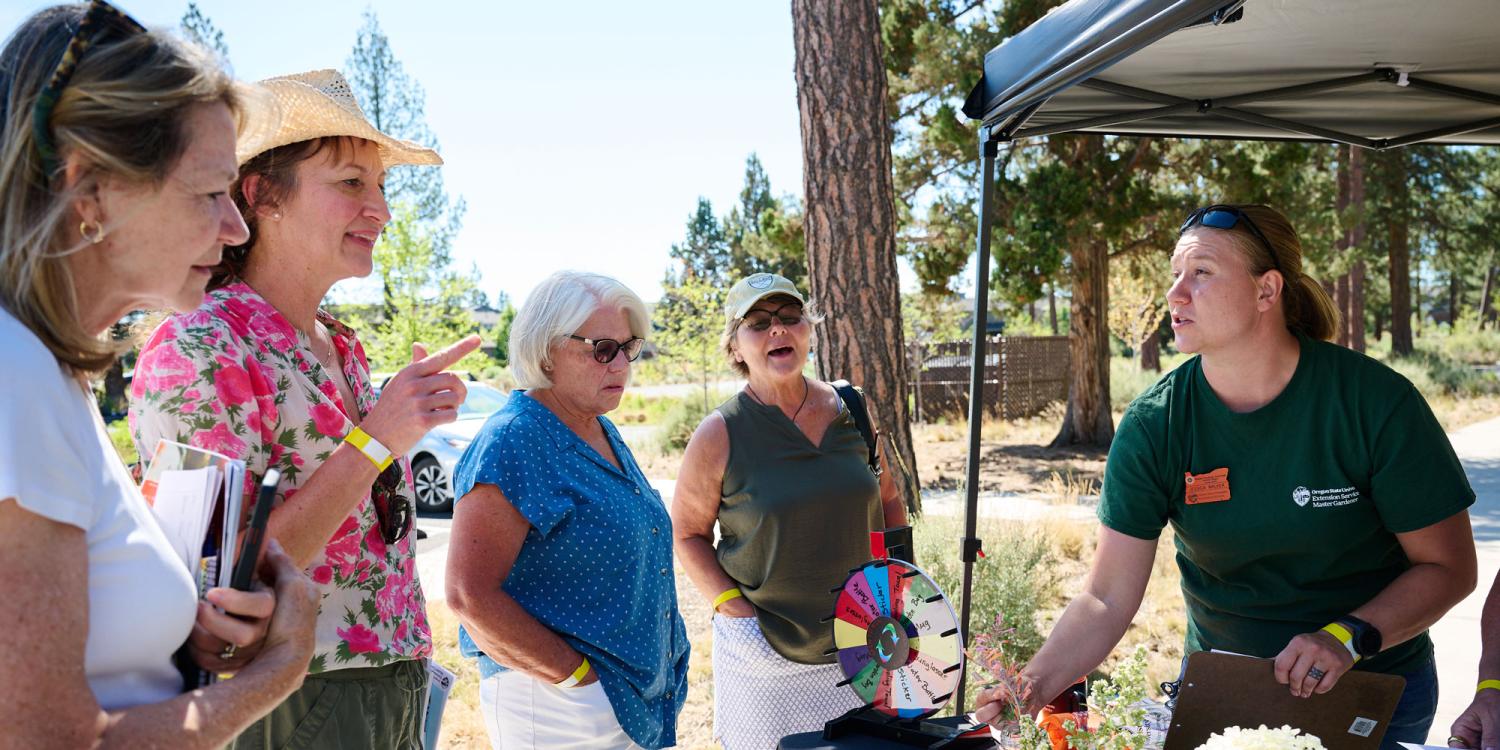
Volunteers supported 53 outreach activities, answered more than 422 gardening questions and staffed events such as the Central Oregon Home and Garden Show, where they reached 866 people and taught four classes.
Food access and outreach grow impact
Master Gardener volunteers also expanded food access and education across the region.
They taught 15 classes on backyard food production, including vegetable gardening, seed starting and seed saving. Outreach included underserved communities in La Pine, the Confederate Tribes of Warm Springs and a dual-immersion school in Bend that serves a high number of students from low-income families.
Master Gardener volunteer Beth Young taught 57 class sessions, reaching 1,191 students. Three family garden workshops were also offered at the school.
Volunteers manage two community gardens with more than 140 renters and maintain three demonstration gardens. In 2025, they grew and donated 1,314 pounds of produce to NeighborImpact, the region’s largest food bank.
Public value
This work helps Central Oregon communities adapt to growing environmental and wildfire challenges.
By combining education on ecological landscaping, wildfire risk reduction and food production with a strong volunteer network, Oregon State University Extension Service helps residents use less water, reduce chemical inputs, improve safety and increase access to fresh food.
These efforts support healthier landscapes, stronger communities and more resilient local systems.