Oregon’s more than 79,000 family forest landowners manage 3.6 million acres of private forestland, contributing significant economic, ecological and social value. These landowners have diverse goals and face complex challenges in ...
Professional tree measurement tools can be costly, but the OSU Woodland Stick offers an affordable, simple and user-friendly alternative. Created by the Oregon State University Forestry and Natural Resources Extension Program, this ...
Hay is one of Oregon's top agricultural commodities, ranking third in the state in 2022 with a total value of about $785.5 million. This included 2.78 million tons of alfalfa hay, valued at around $488.2 million, and 1.28 ...
Small-acreage farms in Oregon play a crucial role in the state's agricultural landscape. According to the 2022 Census of Agriculture, a majority of the 35,547 farms in Oregon are small acreage, meaning they are 50 acres or ...
Oregon State University's Farm to School program, housed in the Center for Resilient Agriculture & Food Systems, works across OSU Extension programs to maximize the benefits for kids, food producers and processors, and ...
The cattle industry is a significant part of Oregon's economy, contributing over $900 million annually. It consistently ranks first or second among the state’s most-valued agricultural commodities, providing numerous employment ...
Feb 2025 |
Impact Story
Credit Oregon State University (Cropped from original)
Accurate harvest timing helps vegetable growers meet market demand, minimize pest damage and schedule labor efficiently. Traditionally, growers plan planting and harvest dates using a calendar and the crop’s estimated days to ...
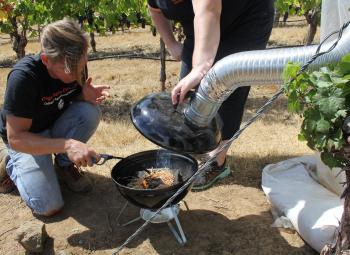
Oregon ranks fourth in wine production in the United States, following California, Washington and New York. The state is renowned for its high-quality wines, particularly pinot noir and chardonnay, and has several distinct ...
Grass seed is commonly used to establish and maintain lawns in residential, commercial and public spaces, providing aesthetic appeal and recreational areas. It is essential for creating durable and resilient surfaces for sports ...
The cattle industry is a significant part of Oregon's economy, contributing over $900 million annually. It consistently ranks first or second among the state’s most-valued agricultural commodities, providing numerous employment ...